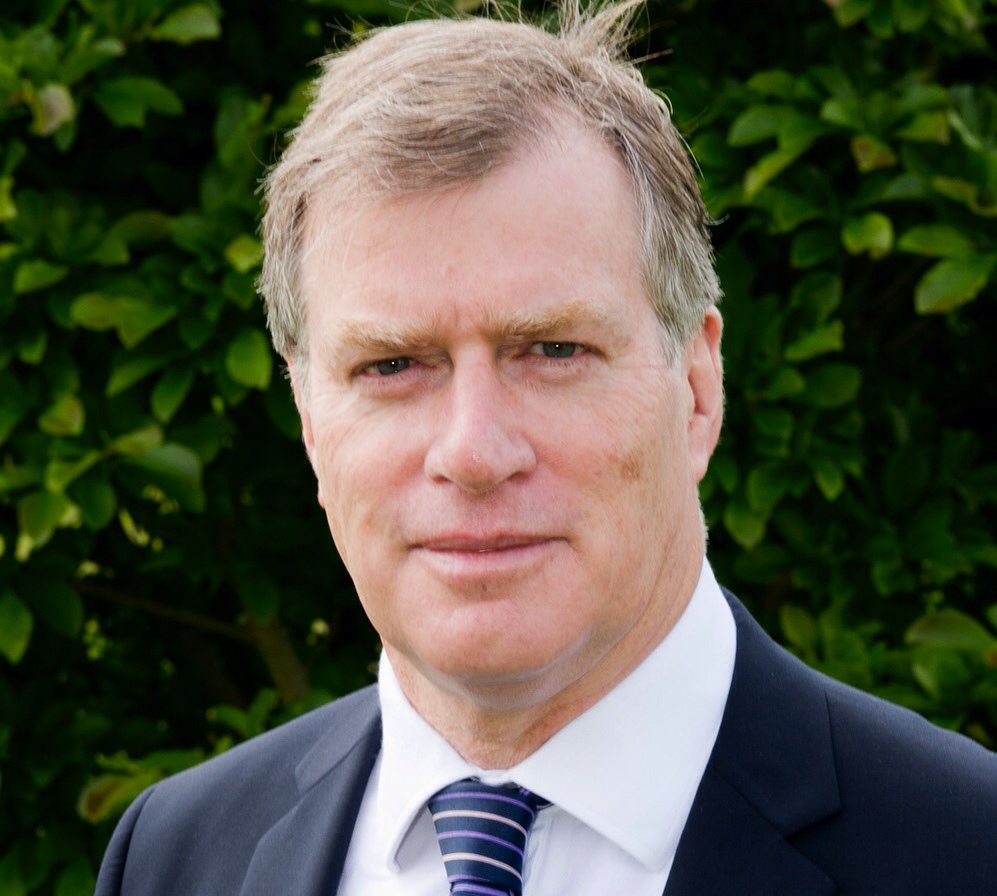
Candidate Statement of Jamie Athill

I’m Jamie Athill, I was born and raised in Norfolk and I’m standing as the Conservative candidate in Norfolk’s Police and Crime Commissioner election because I want to cut crime by:


  • Improving Norfolk Constabulary’s public accountability, so people understand how the police help them and how they can help the police
  • Underpinning the Chief Constable’s operational independence, so we get the best policing delivered by well-trained, well-motivated police officers, PCSOs and civilian staff
  • Supporting the organisations and charities that help victims and reduce reoffending with business partnerships that enable, not ‘privatise’, these public institutions, putting the victim first.


The PCC needs to be a tough, fair-minded person who will take a fresh and independent look at cutting bureaucracy, with a hands-on approach to identifying local priorities. Thirty-five years of military experience has taught me that when times are difficult it is teamwork and innovation that deliver results, not infighting or living in the past. I share with many Norfolk people the values of personal responsibility, mutual respect, self-reliance and independent thought – and that we must make every penny count.


The PCC’s job is not just about setting police budgets and priorities; it’s about long-term crime reduction, about sharing best practices with local government and local businesses and renewed community engagement – driving improvements through collaboration with the whole criminal justice system.


My team will bring Norfolk criminal justice, victim support and business experience to focus on the front line. We’ll be upfront with the people of Norfolk, replacing the appointed Police Authority’s closed shop with elected openness and accountability, so we keep Norfolk one of the safest counties in England.


You can learn more from my website www.jamieathill.org.uk , which includes a growing diary of campaign events leading up to the election on 15 November.


Posted in Candidate Statements, Conservatives | Tagged | 4 Comments

Super Tuesday

If I have my maths right next Tuesday (23 Oct) may be remembered by future Police and Crime Commissioners as the day they finally found out for sure who they were up against on 15 November – a key moment in the campaign, when all the lists on this and other websites can agree on their final update, as returning officers publish the statements of those nominated.

It's a tense moment in a campaign when people work out how 'their' vote will be split, though the dynamics of a Supplementary Vote election make the landscape slightly different, with second place not necessarily meaning failure.

But for those who will finally triumph this period is not just an election, but also a time of preparation. Given the compressed timetable when PCCs take office, with so much needing to be done within the space of a few weeks, those who win need to be ready to go as soon as the election is over.

A propitious day then for Policy Exchange to hold a conference for PCC candidates and other on 'Setting Priorities and Preparing for Office'. Will candidates sneak away from their campaigns to network, compare notes and enjoy a good think, or will they view that as a luxurious way of treating precious time? Will they want to look confident by attending, or will they risk looking like they are missing a free opportunity to prepare for their longed-for responsibilities?

I note that the think tank most well-known for their association with PCCs have decided to tackle head-on the role of the private sector, and in so doing give air time to former Chief Constable Tim Brain, not known for being a fan of the new role. Hazel Blears is there, and the Guardian's Michael White, as well as Damian Green, to give the view from the cells Home Office. A fair diversity of heavyweight views then, and not a parade of Policy Exchange's friends.

I'm glad to hear an emphasis on priority setting. I have waxed lyrical on this before, more than once, way back when I had my own campaign. In my view, one thing that can go wrong is that undulations in Home Office crime categories or a flurry of press interest can form a list of offences or behaviours that imprison those whose responsibility it is to set priorities. They may feel they merely need to recognise the list, and so the priorities become offence types that are going wrong now, and may give a false impression of progress when they regress to the mean, when priorities really should be about bringing needed change.

And I'm glad to see a conference that meets the 3 criteria for attendance that I used to set when a Community Safety Manager:-

1. The topics and speakers represent a good use of one's time.

2. It's free (well, it is if you are a candidate – may as well get something for risking that 5 grand deposit, eh?)

3. It's not in London (and in this case, being in Birmingham is in an area where my visitor stats show a disproportionately high interest in this election).

And then there's Kay Burley – bonus!


Posted in Resources | Tagged , | 3 Comments

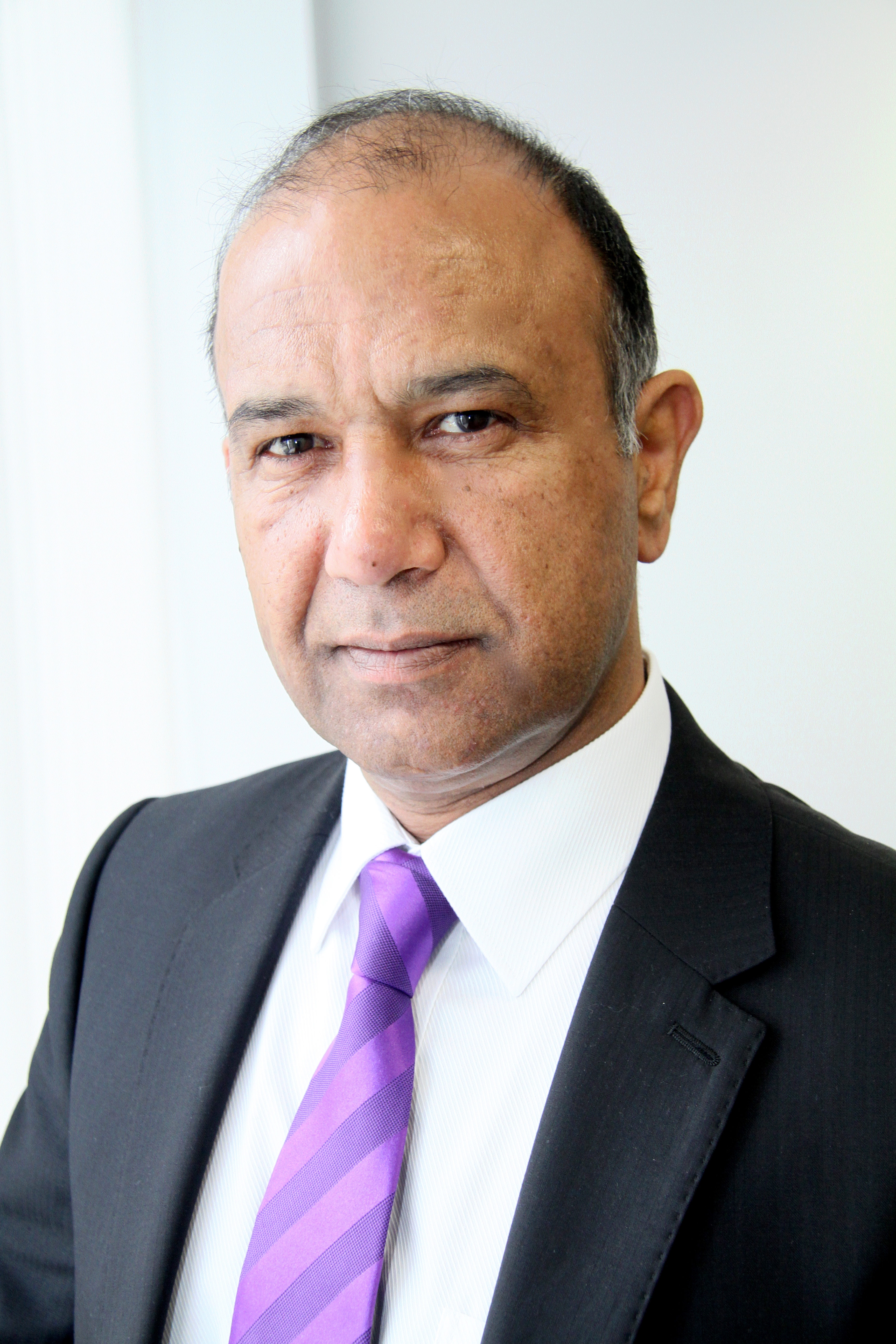
Candidate Statement of Sultan Alam

Sultan Alam is standing as an Independent Candidate for Cleveland Police and Crime Commissioner. If you are intending to stand to be Police and Crime Commissioner where you live, you can submit your own Candidate Statement, so get in touch at Editor@TopOfTheCops.com. Others are on the way, and we are looking for 400 words, and a photo of you to which you have rights.

During my police service I received commendations from Crown Court Judges on two separate occasions – for bravery and for tenacity in carrying out my duties. I also received a commendation for saving a life. Before I retired I was decorated with the Distinguished Service Medal

I have an in-depth knowledge of the workings of the police service and of the Criminal Justice system. As local people will know, I have seen the Criminal Justice system from many different aspects. I spent many years, fearlessly, fighting for justice and stood my ground, for over 17 years, fighting for the truth and for what is right – I will represent the people of Cleveland with just as much tenacity, strength and passion.

One important element of the fight against crime that seems to have largely escaped serious attention by candidates is the police themselves. I have said many times in the past; “there is no doubt that the great majority of our police officers are decent, dedicated and hardworking Police Officers”: but there is always room for improvement. What I propose to do, is ensure that the Chief Constable:


  1. Accepts nothing but exemplary professional conduct from all employees.
  2. Promotes officers and staff purely on merit and ability
  3. Combats inefficiency thereby releasing more officers onto the streets.
  4. Rigorously enforces the Police Code of Conduct
  5. Reduces expense claims of senior officers thereby releasing more money for essential services. Spending of taxpayer’s money should be done wisely and sparingly. I will state here and now that, if I am elected, I will not make any claim for personal expenses – that includes meals, refreshments, travel or accommodation etc. – throughout my term in office. This will, in effect, save the taxpayer many thousands of pounds.
  6. Review all private sector contracts to ensure that the taxpayer is getting value for money AND an efficient and professional service – these will remain under constant review.

My priorities will be a multi agency and multi-faceted approach towards:

  1. Crime prevention and reducing the fear of crime, thereby improving the quality of life for everyone
  2. Adopting a “Challenge – Educate – Enforce” approach towards any and all forms of anti-social behaviour
  3. Ensuring that the rights of victims are always at the forefront in the criminal justice process
  4. Innovative and effective rehabilitation programmes to reduce re-offending
  5. Always taking into account the requirements and concerns of the “Cleveland Community” in the decision-making and the policy directing processes.
  6. Lobbying for appropriate sentencing of offenders.

    http://alamforpcc.co.uk

Posted in Candidate Statements, Independents | 1 Comment

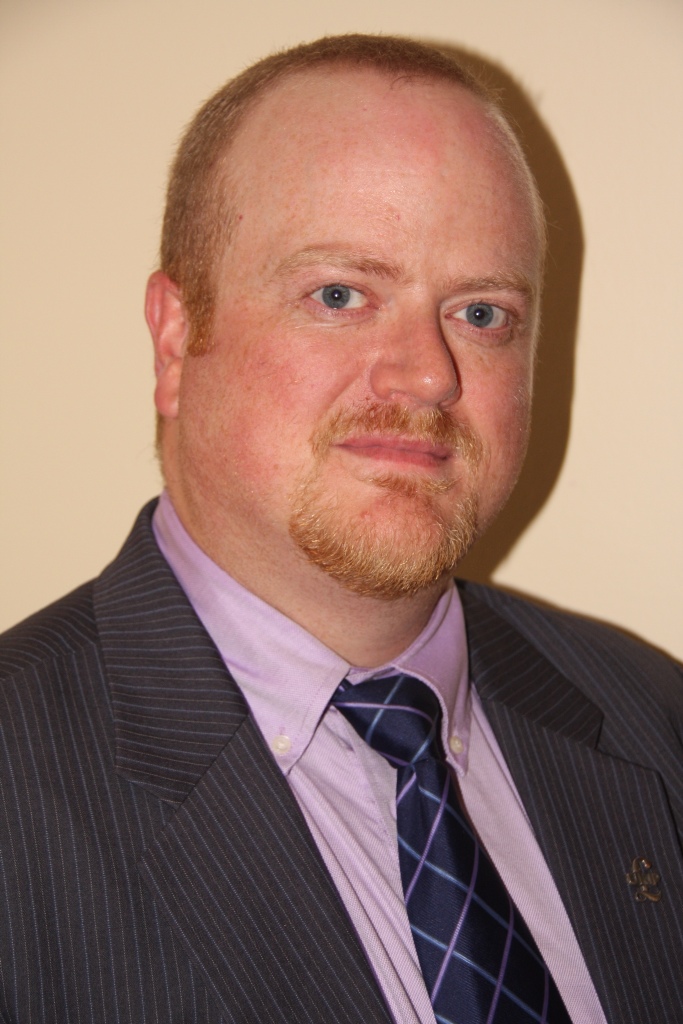
Candidate Statement of Barry Cooper

Barry Cooper is standing as the UKIP candidate to be Police and Crime Commissioner for the Thames Valley Police Area


I am a normal person living in the Thames Valley. I am not a professional politician seeking a comfortable post to cap off my career, or even worse to use the post of PCC as a step on my personal political ladder climb. My team is strong, with my intended deputy David Kennedy being a veteran of 32 years in the prison service, including a term as governor of the Aylesbury YOI. There is no shortage of ideas, expertise and common-sense in the “UKIP Team”.


My emphasis will be ensuring that the Thames Valley Police retain as much operational capability as possible in the face of the ridiculous cuts that have been imposed. The safety and protection of the law-abiding majority should not be jeopardised while the government wastes money on vanity projects such as HS2 and foreign aid.


I will be an advocate and voice for normal people, completely accessible and accountable to my constituents. I will set up mechanisms for consistent dialogue between my office and all of those in the Thames Valley, and will work closely with partners such as Victim Support in this process.


Unlike some of my opponents, I have not forgotten that the police are my constituents too, and that their concerns, opinions and interests need to be taken into account as much as any other. I will fight to insulate the “front-line” police officer as much as possible from the negative effects of Westminster policy and priorities. I promise to raise morale by significantly reducing bureaucracy and paper-work. I will scrap wasteful and resented (by police and public alike) “quota” or “target driven” policing.


UKIP is not a party built around a stifling central ideology unlike the three old parties, and as such I am in a position to act far more independently than any other party affiliated candidate. My commitment to the Thames Valley and its police force can be given freely without concerns for ideological diktats from disconnected party policy gurus.


It would be a shame to squander a rare chance for an opportunity to inject some actual democracy into a facet of how we are governed by voting in a mouthpiece from a static establishment party that will use the role to score political points on the other static establishment parties.


Posted in Candidate Statements, UKIP | Tagged | 1 Comment

Withdrawal Statement of Khan Juna

It is with great sadness that I have made the difficult decision to withdraw from the elections to be Thames Valley’s first Police and Crime Commissioner.

I put my hat into the ring after much soul searching – and after watching the increasingly politicised campaigning with candidates “on message” from their party HQs and with no “local” manifesto. Having been a member of the Police Authority for 9 years I was very concerned about the possible politicisation of policing in Thames Valley and the subsequent loss of public confidence.

However, despite the Home Secretary’s insistence that she wanted to see high-profile, high-quality candidates from beyond the world of politics, this flawed piece of legislation means that it is impossible for an independent candidate to effectively campaign in an area like Thames Valley with 3 counties, 21 constituencies and 2.2 million residents.

The hurdles facing independents include the need to provide 100 signatures in support of their nomination, including name, address, voting area and voting number. To obtain this I have had to directly approach the returning officer for each area and manually trawl through their records – with very little practical support. Political candidates are simply required to demonstrate their party’s nomination.

Without a party political “machine” with a network of MPs, councillors (at county, district, town and parish level) and party loyalists practiced in campaigning, the 2200 square miles of Thames Valley presents an impossible challenge.

The deposit required to stand has been set at £5000 – 10 times that asked of candidates standing as an MP and the cap on campaign spending is £303,303. Without access to party funds, unless an independent has substantial personal wealth or rich friends it would be difficult to raise the funds needed to effectively campaign right across Thames Valley.

The government has also refused to fund a mail shot to inform residents about all of the candidates – a democratic service paid for in all parliamentary, mayoral and European elections. Instead the government has offered candidates 300 words on a web site which will be available just 3 weeks before the elections. And the 300 words include the name, address and telephone number for my agent. So with, effectively, only 250 words to explain my skills, experience and manifesto this really is an election by sound bite and the public deserve better.

The people who don’t regularly access the internet, people with sight difficulties and those who are vulnerable or isolated will not know about the range of candidates and what they stand for – if they are even aware of the election at all. And the unfamiliar 2nd preference voting system is likely to further confuse the public.

These are elections which nobody wanted, which few people know about and which, despite the insincere rhetoric of government, have turned into yet another party political campaign. And it is interesting that the architect of this policy, the former Policing Minister, Nick Herbert MP, has himself walked away from the problem, a mere 9 weeks before the elections: a move that can only be interpreted as moral cowardice.

With the odds stacked against independent candidates – a challenge exacerbated in Thames Valley given its size and geography – I have made the difficult decision not to stand in these elections.

This is a flawed policy that had been badly implemented and in these political elections I believe that the public are the real losers – uniformed about the election, ill informed about the candidates and what they stand for and with a serious risk of the politicisation of policing.

November 15th will not be a good day for policing in England and Wales.

With regret,

Khan Juna
(former Chairman of Thames Valley Police Authority)

Posted in Uncategorized | 11 Comments

The Church of ACPO

I had intended to say something about the Association of Chief Police Officers “Guidelines for Interaction with Police and Crime Commissioner Candidates” before it moved steadily down my list of things to do, until I was reminded by what Bernard Rix had to say about it.

Bernard has highlighted one candidate who may or not be in breach of the guidelines, and it needs to be said that such breaches are not hard to find.

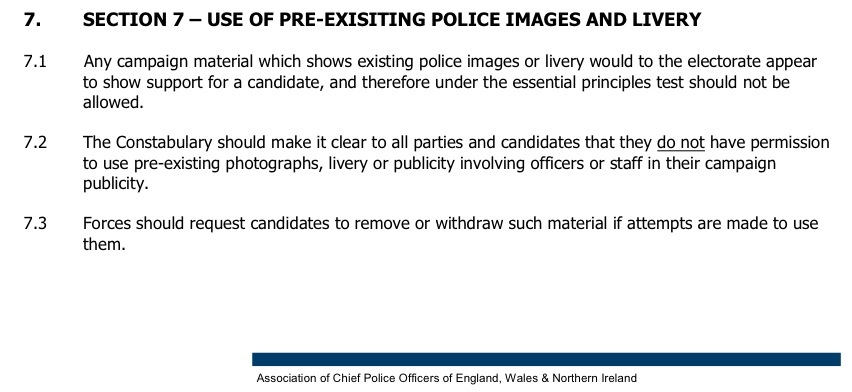
Take section 7, which opines on the issue of pre-existing police images

What's a 'police image'? Is it an image that falls under a force's copyright, or is this an attempt to cover images of police officers, equipment and buildings, no matter to whom those images belong? If it is the former, the restriction hardly needs to be stated, but if the latter then it produces a range of bizarre consequences.

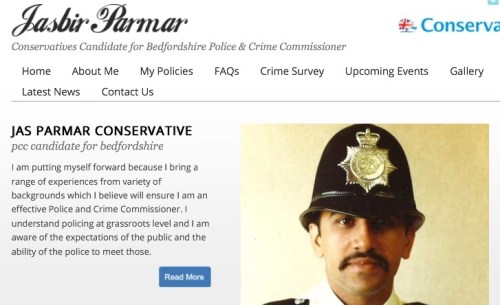
Jas Parmer, Conservative candidate in Bedfordshire, includes a photo of himself on his website, from when he was a police officer. Would anyone really suggest he needs police permission for this?


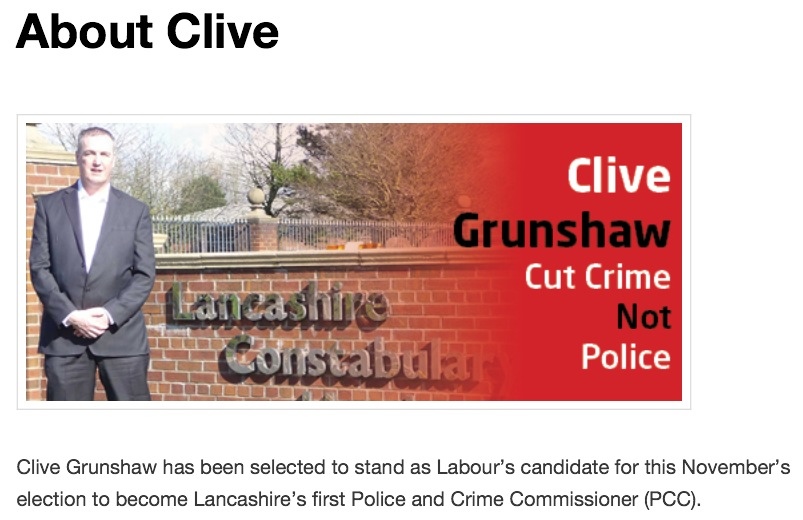
TopOfTheCops regular Clive Grunshaw, Labour Candidate in Lancashire, illustrates his website with a photo of him stood next to a brick wall – from Lancashire Constabulary Headquarters.


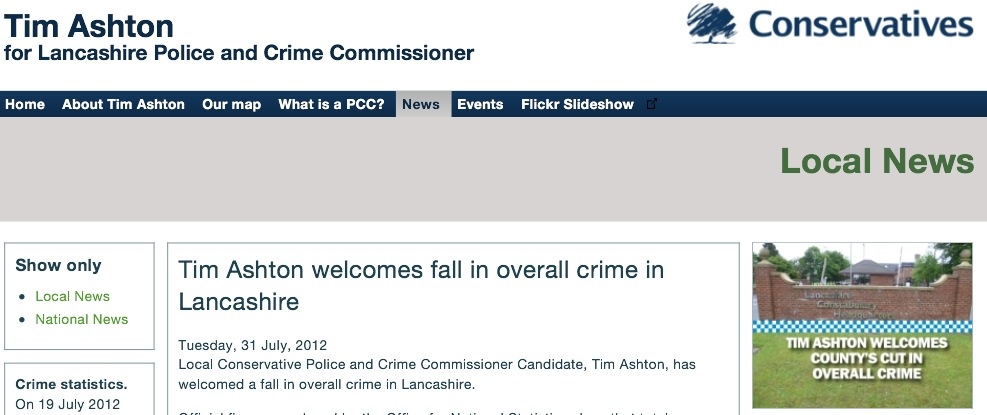
His Tory rival Tim Ashton, uses the same wall on his site.


Do ACPO expect Lancashire Constabulary to leap into action to defend their rights over this wall?

Of course candidates are going to use images related to police and crime in this election. Some will have extensive libraries of images from their past achievements in policing and crime reduction, whereas others will need to take any opportunity to pose next to a passing police officer, police car or, if they're not quick enough, by less-mobile police premises. What is curious is the idea that this might be taken to imply police support for the candidate.

But this is the Church of ACPO – when agreeing on professional practice they formulate something called 'doctrine' and they expect obedience from their communicants. Never mind that their pronouncements actually come from a private company, and lack any special legal force.

There are other issues with the guidance. Elected representatives get a degree of engagement for which candidates, as ordinary citizens, apparently don't qualify. Except that some of them will be elected representatives, and will have privileged access. The curious thing here is how ordinary members of the public appear to be accorded only a third-class status by ACPO, beneath elected representatives and ACPO members.

There is the counter-productive requirement at 6.1 to publish all information given to candidates.

And then there is what looks like an attempt in section 13.6 to extend restrictions on police officers, to ensure they don't sign nomination forms. Of course, police officers aren't banned from signing nomination forms. There is nothing to say their assent to a nomination is an expression of support or an attempt to persuade other people to vote for them. It would be brave to attempt to define such a signature as political activity, when the senior judiciary now accept that magistrates can stand for PCC without breaching their impartiality, and that sitting magistrates may be able to engage in leafleting.

I can see that ACPO may have the nightmare where a particular candidate attracts 100 signatures from officers in the local force, as might very well happen where a candidate opposes problematic police pension reforms. Senior officers may feel they need to summon the menace of career consequences for offences which don't seem to exist, but surely that de facto extension of the law is exactly the sort of policing we need to avoid, and we need to remember that police officers have rights as citizens too.


Posted in Perspectives | 5 Comments

Not an easy fight, but the right fight

Anne Marie Carrie is Chief Executive of Barnardo’s, who have asked for this article to be posted on the same day as it is featured on the Huffington Post


In opening up law enforcement to public influence we must guard against the temptation to opt for populist policies which risk sidelining the youngest and most vulnerable victims.


The Government’s introduction of police and crime commissioners in England and Wales will be a powerful channel for communities to voice their views and hold forces to account.


But, with electioneering for the first 41 underway, candidates must make sure that they are clear in their own hearts and minds that they will not lose sight of the most fragile in the clamour to win office.


Right now we have a marvellous opportunity to make serious gains in the fight against child sexual exploitation.


However, I am concerned that there may be commissioner candidates who are presently ill prepared for the decisions they are going to have to make. It will be difficult for them to avoid focussing on the loudest voices, whilst those who find it hard to speak up for themselves remain silenced.


Children and young people are particularly at risk of being overlooked. They do not have a voice in elections because they cannot vote and they are more often seen as causing crime, than as victims of it, despite youth offending rates falling for years.


That’s why charities like Barnardo’s and its supporters have a duty to speak up on their behalf.


Police prosecutions of men who sexually exploit children are rising, but sadly we are now working with more boys and girls who are abused in this way than ever – up 8.4 per cent on last year. There is still a worrying lack of awareness of this issue across the board.


It isn’t an easy fight, but it’s the right fight.


This abuse is complex and largely underground; 1 in 6 young people we have worked with have been trafficked around the country, rising to 1 in 2 in some areas, and there are cases where the perpetrator is a victim too. This is why Barnardo’s wants to support commissioners as much as possible to get it right.


The more we learn from each other and understand how to tackle child sexual exploitation, the more chance we have in stopping this scourge on our society.


At Barnardo’s we are asking candidates to sign up to our ‘cut them free’ campaign and if elected take the necessary steps to tackle this abuse within their Police and Crime Plan. So far 36 candidates have already made that pledge, and whilst not all those who will join the race have declared, we still have a long way to go before polling day on November 15.


The east and north east regions are seriously lagging behind in support of our campaign to prevent sexual exploitation. Worryingly only two candidates in Yorkshire have signed up, despite this crime having a high profile in the region where serious failings to stop this kind of abuse were recently exposed and five Rotherham men were jailed in 2010 for a total of 32-and-half years for sexually abusing and grooming girls as young as 12.


We have made ourselves available at Barnardo’s to work with police and crime commissioners to support them to understand this difficult issue and respond in the right way. We want government to work with commissioners to ensure they are tuned in to the national efforts to tackle child sexual exploitation so we see real improvements in preventing this horrible crime.


We will never tire in our fight for the right of the voices of these vulnerable boys and girls to be heard.


Posted in Perspectives | Tagged , | 3 Comments

Deep and wide?

Nominations are open, and will close a week on Friday, so the latest YouGov-Cambridge poll commissioned by the Royal United Services Institute is well-timed to give that final push to prospective Independent candidates balancing the decision to run against the temptation to hold on to that £5,000 deposit.

The poll (with full results here, analysis here, and Martin Beckford's Telegraph commentary here) revealed a range of views as to whether the public believe that Police and Crime Commissioners will help or hinder the fight against crime, whether the public feel they understand the PCC role and whether they are likely to vote at all – all interesting stuff – but crucially they were also invited to express a view on whether they approved of the involvement of political parties.

Overall, 61% said they disapproved of candidates being supported by a political party, rising to 74% for the over-60s, which is important as, while respondents of varying ages were roughly equally likely to say they would vote, previous experience suggests that the over-60s are more likely to actually show up on the day. Only 11% approved of party political support, and only 19% were undecided.

The hearts of Independents across the country will be cheered by this news. Are they finally catching a break? Is this confirmation that the anti-politics feeling they may feel themselves is widely shared by the general population?

Perhaps.

But I'm going to retreat to boring political-scientist-mode now. While the anti-politics feeling may be widespread, how deep is it? We don't know yet whether this disapproval is strong enough to outweigh other considerations, such as actually knowing anything at all about the candidates, or having had some form of contact from them, which is what the red, blue, yellow and purple labels and the bunches of dedicated leafleters provide. And we don't know the dynamics of how this works in the polling booth, where the temptation to back someone for positive reasons has to do battle with the temptation to vote for an otherwise less-favoured candidate in an effort to keep someone else out. Nor do we know whether this represents a general feeling of anti-politics, or something specific to an election that involves policing.

What we do know is that this is an election where having a second preference available means that voters can better afford to vote how they feel, before retreating to a safe option for their alternative vote. Though we don't know how many of them appreciate this. And we know that the Centreground ComRes poll in May showed only 26% thinking they would vote for an Independent, though this seemed to hit Conservatives more than other parties.

Talking to some Independents shows they have a clear strategy of seeking to come at least second in the total of first preference votes, and then benefitting as supporters of parties prefer an independent to that of a different party. It could work, particularly if political party votes in an area are fairly evenly split between maybe four fairly non-descript party candidates, and if voters have a single clear Independent choice who is able to make their presence felt. Whether and where that happens depends on what nominations actually come in over the next two weeks.

And yet my favourite question from this poll is not about parties or voting intention, but about the impact of PCCs. Respondents were asked whether the reform would mean that some areas would have worse policing than others. Why not ask whether some will be better, or some better, some worse? Does this reveal the bias of those commissioning the poll, or do we just expect more truthful answers from the British public when we assume pessimism and grumpiness?


Posted in Perspectives | Tagged | 2 Comments

Candidate Statement of Nigel Bonson

Nigel Bonson is the Conservative Party Candidate for South Yorkshire Police and Crime Commissioner.

Nigel Bonson has spent his entire working life within the criminal justice system. He is currently an independent member of the Parole Board ensuring public safety is a priority when making decisions regarding a prisoner’s release. Nigel was a police officer with Greater Manchester Police for 30 years attaining the rank of Chief Inspector and latterly responsible for Criminal Justice Partnerships in Salford.

After a very successful police career where he specialised in community policing, partnership working, crime reduction and domestic violence, Nigel moved to become an Associate Trainer with The National Police Improvement Agency. Nigel also worked as a Neighbourhood Renewal Advisor supporting local partnerships in the delivery of regeneration and crime reduction working under contract to the then Labour government.

Nigel has completed secondments to both regional and national government including Home Office Safer Cities Co-ordinator, managing the Regional Crime Reduction Team at a regional government office, and working on generating crime and disorder reduction activity across many regional programmes. He has regularly briefed ministers on these activities and drafted speeches on their behalf.

Nigel has extensive experience of gun and gang culture which we have seen all too tragically in recent weeks and represents a continued threat to our communities. He has considerable experience of working in deprived areas with correspondingly high crime levels including Labour heartland estates. He has international policing experience, including tough areas like New York and Philadelphia where he worked to share best practice between U.K police forces and their American counterparts. On behalf of the British Government he visited Chicago to work with the Mayor and others to explore policing and housing policies.

Nigel Bonson has the courage to take the difficult decisions which will be necessary in the role of Police and Crime Commissioner. Unlike his opponents however, he has real experience of the role of a police officer and this gives him the means and the credibility to create effective working relationships with officers, officials and partners. Critically he says, he has the necessary insight to tackle inefficient working practices on the behalf of South Yorkshire people.

Nigel says, “Contemporary negative press surrounding the police does highlight a need for us to recognise and challenge mistakes but they should not be allowed to shackle our force. We must work to ensure that officers are able to achieve maximum efficiency in reducing crime whilst ensuring public confidence and pride in South Yorkshire Police.”

“The role of Police and Crime Commissioner is not party political. I will be signing an oath of impartiality which guarantees that I will not be influenced by Government, the Opposition parties or the unions. We must not play politics with public safety. That is immoral. That’s not British policing. This is a unique and special opportunity to improve our police force on behalf of the people it serves; not a stick for political parties to beat each other with and must never be used to interfere with the Chief Constable’s operational control. I will, of course, fight for budgets that allow the police force to be of maximum effect in reducing crime. In return I will expect the police force to deliver on that.”

“Many candidates talk of returning officers to “front line policing”. These are empty words unless you have the ability to identify exactly what that front line is and the bravery to say what it is not. I have the skills and experience to work with the public, the police and their partners to identify and prioritise exactly where our resources are most needed and I have the courage to take decisions which make sure they get there.”

“My aim will be giving safety back to the public by giving strength back to the Force. Tackling Crime Together.”


Posted in Candidate Statements, Conservatives | Tagged , | 8 Comments

Candidate Statement of Mervyn Lambert

Mervyn Lambert is standing as an Independent candidate to be Norfolk PCC

My name is Mervyn Lambert. I am Norfolk born and left school at 15 to work on the family farm. At 20 years old I left to make my own way in life and have built up a successful plant hire and traffic management business employing approximately 200 people. The main reason I am standing is because I strongly believe the Police should be free from political pressure and I am offering myself as an Independent alternative.


Because I've suffered high levels of theft from my business over the years, together with arson and vandalism, and personally have suffered from burglars and pickpockets, I certainly know the bitter taste that comes with being a victim and I want to do something about it.


I want to see more of the yobs who get involved in unsociable behaviour, the individuals who burgle our houses and those who sell our young people drugs etc and blight our lives brought to justice, in order that the balance of fear the law abiding individuals feel is transferred increasingly onto the criminal in that they will be caught and have to pay for their crimes.


However, the biggest challenge facing the new Police and Crime Commissioner is dealing with the £27 million the Government has told the Norfolk Police they will lose from central Government by 2015 and still maintain a credible effective service. I truly believe I can achieve this, for I have extensive experience gained in the private sector that includes working to strict financial budgets and I am up for the challenge ahead should the public choose me.


Posted in Candidate Statements, Independents | Tagged , | Leave a comment